
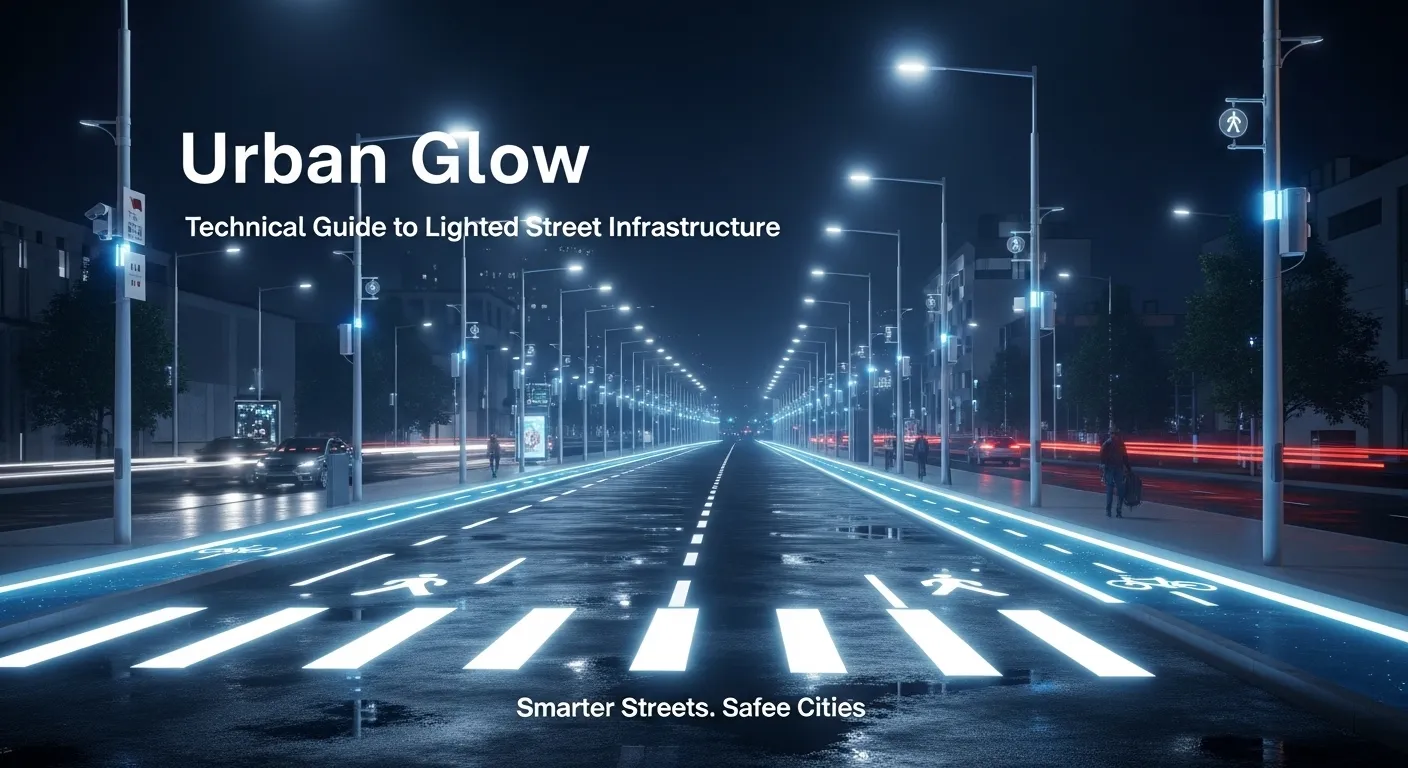

A lit street is not but a night navigation contrivance; it is a utility that outlines the safety and usefulness and social-economic well-being of a modern city. The system of smart, interconnected networks of LEDs to replace the outdated high-pressure sodium (HPS) systems will have reached critical mass. This has been a technological change of the previously passive utility of the lit street into an active element of urban infrastructure that informs, observes the situation in the environment, and takes part in the active regulation of the use of energy.
The character of a lighted street in a very straightforward manner defines how a community operates when the sun has set. This 2200 words technical treatise concerns the modern lighting engineering needs, incorporation of Smart City needs, and the effectiveness of high-output lighting that has been proven to be effective in lighting human safety and the look of cities.
Physics of Light: What Lumens is.
The Lit street in would be more than the naive idea of light, it would be an exploration of the technicality of the idea. Bright efficacy and consistency have now become the major measures of achievement to engineers.
Luminosity and Watts/unit.
The brightness of a source of light is expressed in lumens, but when considering a lit street, the important one is the illuminance, expressed in lux (lx). The functional requirement of the average residential environment is to have an average illuminance of 5lx to 15lx on the surface of the pavements. This may go as high as 20 lx or more in the case of high-traffic arterial roads to make sure that the driver reaction times do not decrease with the increase in speed.
Luminance and Contrast
Unlike the amount of light that falls to the street, which is termed as illuminance, the amount of the light that is reflected off the surface and into the eye of the viewer is known as luminance and is measured in candelas per square meter (cd/m2). Some of the technical standards which have already been proven include the computation of the so-called Average Road Surface Luminance in a manner that the objects (pedestrians, debris or wildlife) are represented as dark figures on a bright background. This opposition is the mechanical foundation of detection of the hazards in the night.
Spectral Control and LED Revolution.
The turning point to the Light Emitting Diodes (LED) is the key historical phenomenon in the history of lit streets. There is a shift in the focus of saving energy in spectral power distribution of light generated.
Color Temperature and Kelvin Scale.
The biological and psychological consequences of Correlated Color Temperature (CCT) of a lit street are gigantic.
Warm White (2700K to 3000K):
It is the practical requirement of the houses. It inhibits the escape of blue light which has been observed to disrupt the slumber of the residents, as well as the wildlife in the region.
Cool White (4000K -5000K):
It is used in the mostly industrialized areas and large crossroads. The increased blue content causes drivers to be more alert, and gives them a greater peripheral vision, but in most of the municipalities that are Dark Sky compliant, the percentage of the higher blue content is limited.
The energy efficiency of the energy used.
The efficiencies of LED streetlights are more than 150 lm/W. Nonetheless, the thermal power of these high-density chips should be regulated, a functional requirement. Engineers adopt sophisticated heat sinks and thermal throttling to make sure that the LEDs do not reach junction temperatures over 85 o C in order to make the 100,000-hour life cycle of the fixture valid.
Smart City Integration: The Networked Pole.
The light street has now become the foundation of the Smart City this light pole is no longer a lamp holder but a high utility node of a mesh network.
Adaptive Dimming Protocols
Realism Modern dynamic dimming is a realistic requirement. It can then be programmed to light a street with motion sensors and astronomical clocks to turn output down to 20 at times when there is no traffic on the street (e.g. 3:00 AM in a suburb) and turn output up to 100 when a car or a pedestrian is detected. This established solution will end up spending less money on energy in the cities by 40 percent on top of the fundamental LED savings.
Data collection and 5G mini-cells.
The distance between Streetlights is not too great and the power source is unlimited, which implies that these regions are the most appropriate to place 5G small cells and environmental sensors. An active-lit street will also be able to detect the level of CO 2 in the air, data on noise pollution and vehicle traffic and send it to a central system of urban management in real-time.
security practices and crime prevention.
The social-economic reality is a well-lit and safe street. The design should however be deliberate in such a way that no blinding spots and deep shadows are formed.
Disposing of the Glore Factor.
The foe of safety is glare. The streetlights use Full Cut-off optics which are likely to direct all the light downwards. It has eliminated the temporary blindness that is caused to drivers due to what is known as disability glare and eye fatigue otherwise known as discomfort glare. An active road which makes use of shielded optics is a viable requirement in minimization of accidents in the cities.
Psychological Effect and Eyes on the Street.
Sociological research will still uphold the theory of illumination under the Broken windows theory. Street lights are fine, and it implies that there is a place that is maintained and observed. This deters crime opportunities and the area appears safer, so people are more likely to use the places at night and the area even safer due to natural surveillance.
Environmental Consciousness: Dark Sky Compliance.
The practical need to save the dark environment has been converted into law especially on the ever growing lighted streets.
Light Trespass and Skyglow.
Light trespass This is when a street lamp is shining into the bedroom window of a neighbor. This light in the sky over urban areas that covers the stars is known as Skyglow.
The Solution:
The street lamps will also be modern and have a properly calculated lens that will shape the beam of light. Such lenses will give instead of a circular splash of light a rectangle that is just the width of the road and the sidewalk, and eliminate wasted light.
Wildlife Protection:
Amber-colored LEDs are now being deployed in lighted streets at most of the beaches in coastal cities. This has been found to be an effective method of avoiding disorientation of the sea turtle hatchlings by artificial lights as they rely on the moon to locate the ocean.
Lifecycle Logistics and Maintenance.
The lit street maintenance has also become more of a predictive (preventing a failure) rather than a reactive (replacement of a burned-out bulb) maintenance.
Remote monitoring and failure alerts.
A lit street will be equipped with a cellular or LoRaWAN controller. It also automatically sends a notice to the public works department when there is either abnormal current in a particular given fixture or failure to start. This is done away with the practicality of night patrols to detect out of order lights.
IP Ratings and Strength.
Streetlights are exposed to the most adverse weather conditions: heatwave and snowstorms. The set of criteria of a -light street is the IP66 rating that implies that the casing is dust-free and will be able to withstand powerful jets of water. The glass lenses can also be self-cleaning, and also contain a photocatalytic coating, which decomposes organic dirt under the sun.
City Planning: Light Urbanism.
Even though the texture of a lit street is the character of a neighborhood, the aesthetic of a lit street is the cornerstone of the character of that neighborhood.
Architectural Accenting
Cities are illuminated with layers of light. The most unsecured street lighting offers the least level of security and secondary and less powerful uplights or bollard lights of trees offer a feeling of depth and beauty. This is a viable requirement keeping in mind the re-energization of the main street programs that will enhance the rise in the number of people walking and restaurants earnings during the evenings.
Ornamental vs. practical Furnishings.
Replacement of the cobra-head shape of fixtures to acorn or lantern is common in the historic areas. Nevertheless, the state-of-the-art LED technology is also included in the domestic factors. This enables a municipality to appear to have a historic look of having a lit street with the added advantage of having current day energy efficiency and light management. Conclusion: The Future of the Lighted Street.
The history of the lit street can be considered as one of the proofs of the combination of the safety and the technology. We will no longer be flicking the switch on or off, we will have a smart and adaptive network that is conscious of the existence of human beings and what the environment requires. The fact that the exact calculation of the cd/m2 is done to the introduction of 5G nodes makes all the aspects of a lit street a realistic demand of the present-day urbanites.
The Urban Glow will remain efficient and less intrusive, where municipalities will still invest in such smart networks. The original investment in capital is negligible compared to the number of benefits that have been achieved in the form of decreased crime rates, fewer traffic accidents and the improved living conditions in the community. A street with lights, then, is the unknown hero of an urbanized city, and without it the city would not be a 24-hour community, nor would it even be safe, as it would not be clear. Stop seeking other city solutions by looking down the city, we already have the future looking down at us. Take a step further to a safer neighborhood and help to transform to smarter, more efficient and Dark-Sky-compliant lit streets today.