
Trailer Lights When required to be installed – The Comprehensive 2026 Legal and Safety Guide.

1. The Universal Rule: Why Lights are Necessary All the Time.
By regulation (regulated by the Department of Transportation and NHTSA Standard No. 108), the regulations of the United States and Canada (and other European countries) require that any vehicle under tow use a lighting system synchronized with the lead vehicle.
The Obstruction Rule
The easiest reason as to why lights are required is the light obstruction. In all but a few towing cases, the trailer and the cargo conceal the tail lights, brake lights, and turn signals of the tow vehicle. In the event that the car behind you is unable to see your brake lights then they cannot react to your deceleration. Though you might believe that your trailer is small enough to have the bright lights of your truck appearing, federal law still requires that the trailer have a dedicated lighting system of its own, to indicate its precise width and length.
24/7 Compliance
Among the myths is the belief that the lights of trailers are only required at night time. This is a serious safety error.
Brake Lights and Turn Signals:
These are required 200% of the time. It can be noon in the desert, or a spring morning: on turning, or halting, drivers behind you ought to be able to read your mind.
Tail Lights (Running Lights):
They must be turned on when the headlights of your car are on and these can be during nighttime, in tunnels and during rain, snowfall or mist.
Functional lighting is not only a suggestion but a practical necessity and a law regarding towing and road safety. Whether it is a small utility trailer on a weekend project of your own DIY, a luxury boat to the coastline or the trucks of your commercial long-haul trailers, your lighting system is the lingua franca between your load and the drivers behind you. Having proven and certified trailer lights will be more crucial than ever by 2026 when smart sensors and autonomous car detection is in place to prevent disastrous crashes at the rear end and costly legal consequences.
Put simply, when the wheels of a trailer are on a roadway, that trailer should have a specified combination of lights that will be on at all times, either during the day or at night and in all weather conditions. This is a comprehensive guide that covers all the specifications of the trailer lights, including the federal DOT regulations, and hardware required to support various sizes of trailers.
2. Lighting on all trailers is required.
Regardless of the size or weight of your trailer, there is a known and tried standard of equipment, which must be in place and functioning properly before you pull on to a state highway.
Rear-Facing Requirements
Tail Lamps (Running Lights): Two red lights on both sides of the back, to inform the oncoming traffic in the night and the width of the trailer.
Stop Lamps (Brake Lights): Two red lights, which are bright when brakes of the tow vehicle are used.
Turn Signals: These are two amber or red lights, flashing to indicate a change of direction.
License Plate Lamp: there will be one white lamp to illuminate the registration plate on the trailer to be read at least 50 feet away.
Rear Reflectors: When the lights are off, the rear should have two red reflectors to allow a passive view of the rear by other vehicle headlights.
Side-Facing Requirements
Side Marker Lights: You must have amber lights in the front and red lights in the rear. These allow the drivers, who are heading at a 90, angle to be aware of the dimensions of the approaching vehicle.
Side Reflectors: These are passive safety markers that resemble rear and ought to match the marker lights (amber in front and red in the back).
3. Greater Requirement based on Trailer Size.
Trailers are getting broader and longer; therefore, the lighting requirement is getting complex. The reason is that there is a practical need to make the other drivers distinguish between a small utility trailer and a huge wide-load hauler.
The 80-Inch Rule (Wide Trailers)
The law requires you to install additional of the “Clearance” and “Identification” lights when the total width of your trailer is 80 inches or more. It is common to boat trailers, large enclosed cargo trailers, and car haulers.
Rear Identification (ID) Lights:
The rear has three red lights that are placed in the middle-top. This three light signature is a global indication to other motorists that they are following a wide vehicle.
Rear Clearance Lights: There are two red lights at the top and broadest end of the rear to show the vertical and horizontal envelope of the trailer.
Front Clearance Lights: There are two amber lights at the widest and highest parts of the front.
30-Foot Rule (Long Trailers).
You must have a middle-side marker light in trailers over 30 feet in length. This amber light is placed between the front and the rear lights, and serves as a visual point of reference to the incoming traffic to ensure that they do not re-enter your lane too early.
4. Technical Specifications & 2026 Standards
Trailer lights have been changed to practically all LED (Light Emitting Diode) technology. The LEDs are considered the standard that has proven its worth in 2026 based on several reasons:
| Feature | Incandescent Bulbs | Modern LED Systems |
| Response Time | Slow (filament must heat up) | Instant (up to 200ms faster) |
| Durability | Fragile (vibration breaks filaments) | Shockproof (solid state) |
| Waterproofing | Poor (leaky housings) | IP67/IP69K (fully submersible) |
| Power Draw | High | Minimal (reduced strain on vehicle battery) |
Submersibility Requirements
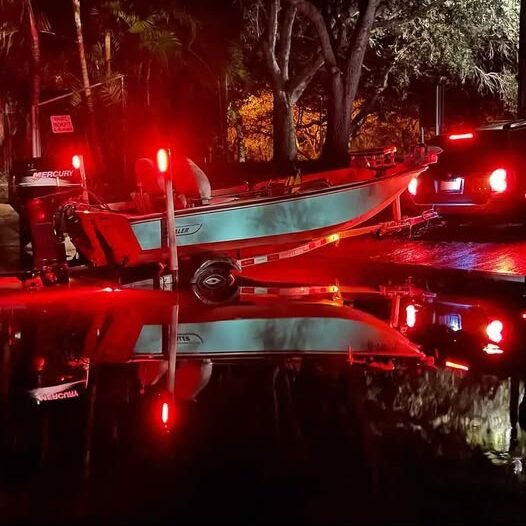
Your lights must be marked as being submersible in case you have a boat trailer. This is an operating need because the warmth of an ordinary bulb falling on cold water will break the glass. LEDs are also cool and are often encased in a waterproof epoxy resin, thus providing the ability to use them numerous times without failure.
5. Connection and Wiring Protocols.
The quality of lighting system will be determined by the quality of the wire used to transmit the signal. The 4-way and 7-way plug standards must be known to have a safe tow.
4-Way Flat Plug: Small trailers with no brakes. It has Ground, Tail Lights, Left Turn/Brake and Right Turn/Brake.
7-Way Round Plug: It is used on bigger trailers. In addition to the simple lights, it also powers Electric Brakes, Reverse Lights and a 12 V auxiliary line to charge the internal battery in the trailer.
Grounding:
90% of the failures of the trailer lights are caused by a bad ground. Bolts needed to securely fit the white wire to the trailer metal frame. In case of very rusted or painted frame the connection will be lost leading to flickering or dark lights.
6. Advanced How-It-Works: Legal and technical barriers.
Q: Do magnetic lights that are temporary make it?
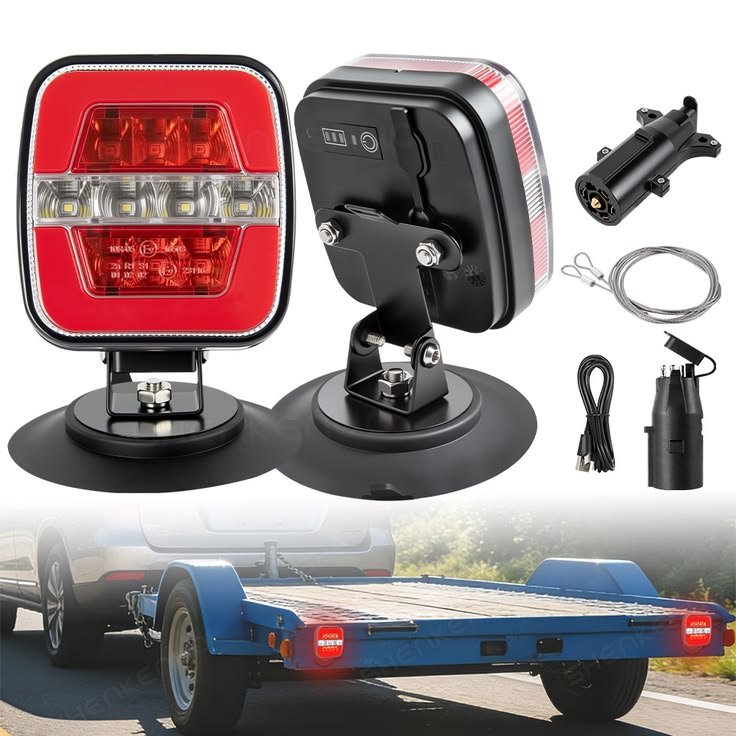
A: Yes, magnetic towing lights are a legally proven and valid solution to temporary towing. You can just slap these magnetic lights on the rear when towing a car or a trailer with a faulty wiring harness and then there is no need to run the wire to the cab but rather just be well within the rules. They are however not expected to be permanent usage since the wires could be pinched or frayed over time.
Q: Will I need to use lights as I will not be towing at night?
A: Absolutely yes. This will always be the case with your turn signals and brake lights. During law enforcement, as you are pulled over and your trailer does not have lighting equipment, you stand to pay a fine and in most jurisdictions you will not be allowed to drive the trailer until it is properly equipped.
Q: What is Rear Overhang Rule?
A: You have to put a red flag on the top of the daytime rear of the overhanging load and a red light on the same at the rear at night in case your load is more than 4 feet in length. This is practical measure in order to prevent underestimation of the cargo by other road users.
A: Can we use wireless trailer lights?
A: LED trailer lights with wireless technology are highly reliable by 2026. These units contain transmitter attached to the vehicle 7-way port to send signals to battery-powered light units on the trailer. Their usage is possible as long as they meet the brightness and color guidelines of the DOT.
Q: My LED trailer lights flicker when my car is off, why?
A: In order to check the plugging of the trailer, a majority of contemporary automobiles send slight electric impulses through the trailer plug. As LEDs have only a low power requirement, they can flicker or blink to such pulses. This is inherent and usually requires a load resistor or special adaptator to correct.
8. the Pre-Tow Inspection Checklist (The “Time-tested” Routine)
This 60-second Light Walk, performed prior to each trip will keep you safe and within the law:
Left Turn: Check vehicle and trailer.
Right Turn: Inspect trailer and vehicle.
Brake Test: This is done by stepping on the brakes or pressing on the pedal by a heavy object.
Running Lights: Turn on your Headlights and proceed to the rear.
License Plate Light: Remember to have the white light on.
Side Markers: nsure that the amber and red side lights are on.
8. Legal Compliance summary.
To stay within the law and as safe as possible, your trailer lighting project must center on three cornerstones to Visibility, Redundancy, and Protection.
Visibility: Maintain the distance between the lights and the cargo or tailgate of the trailer with a 45 degree angle shot.
Redundancy: Use high quality LED kits containing multiple diodes. In case of a diode failure, the others will still keep you visible.
Protection: Your lights can be smashed during the loading process or when reversing to tight spots so recessed mounting or plastic guards can be used to protect them.
Conclusion
Lights on a trailer are not just a matter of avoiding a ticket, but an issue of practical necessity of visibility on the highway. As the basic rear indicators to the expert clearance signals must be provided on 80-inch-wide loads to the safety architecture, each component is an element to the established safety architecture of contemporary towing. Your lighting system will be your final resort against the accidents in 2026, when the amount of traffic will be higher, and the speed of the road will be increased. i.e. spare not your trailer lights. Always, ensure that you use high quality and weather proof equipment, maintain your wiring well assembled and never forget to check before the trip. The next thing is to be responsible by taking the next step of towing and ensure that your trailer is a beacon of safety every time it is on the road. Get rid of the risk of being towed and lightening your load now.